
AI that ships inside the product, not beside it
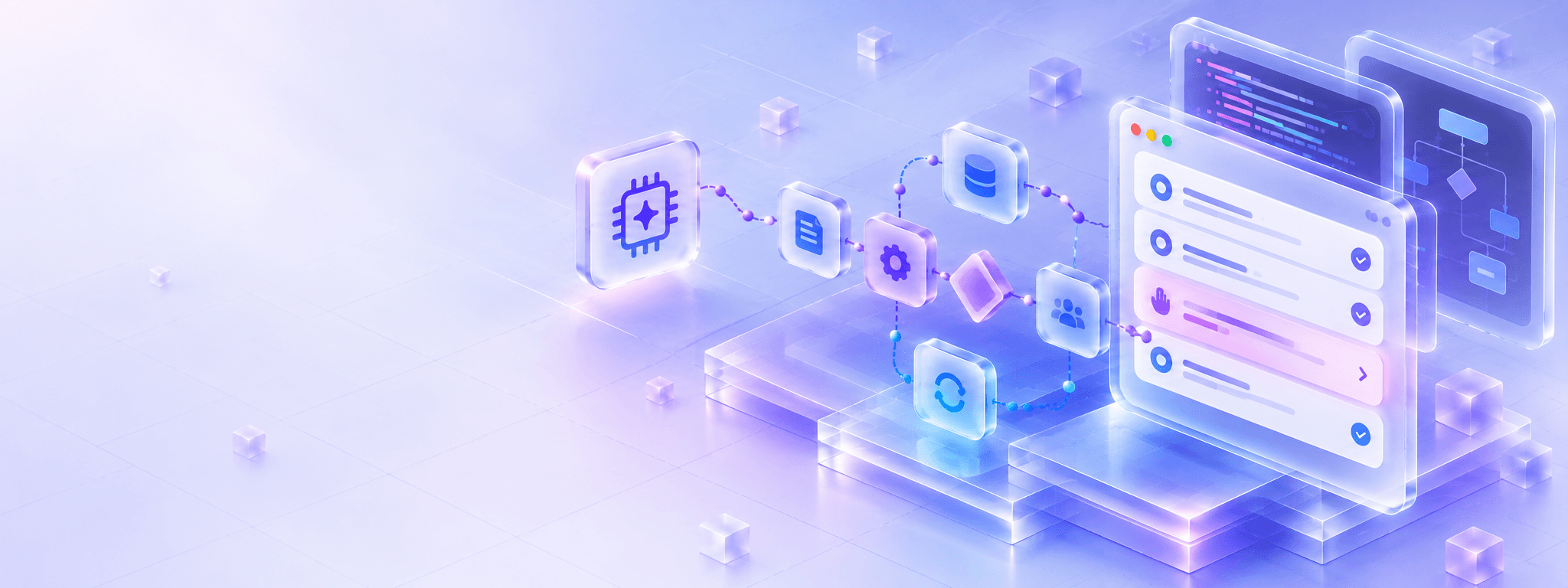
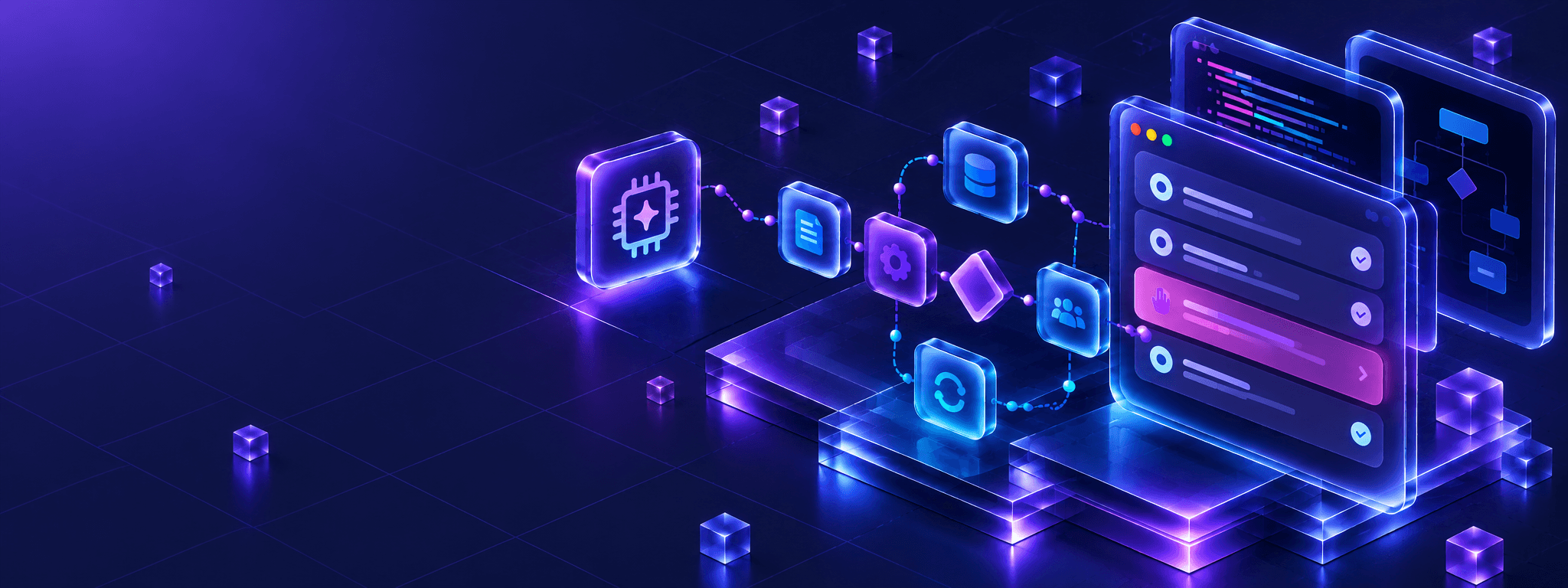
We do not bolt a chat window onto the corner of a screen. Models go where the work already happens — summarising a thread, drafting a reply, pulling fields out of a document — with a visible trail so a person can check the answer, and a path that still works on the day the model is wrong.
Concrete deliverables, not adjectives
- Assistants grounded in your data
- Retrieval over your own records, answers that cite the row or document they came from, and a refusal path when the context does not contain an answer. An assistant that invents an answer is worse than no assistant.
- Document intake
- Extraction, classification and routing for the paperwork that arrives as PDFs and photographs — with a confidence threshold that sends the uncertain cases to a person instead of guessing.
- Voice automation
- Text-to-speech calls on real telephony with keypad capture, so a confirmation can come back as a pressed digit rather than a transcription. Reach runs this today; you can hear it in the demo.
- AI inside existing products
- Features added to software you already run: summarisation on a thread, suggested replies in an inbox, triage on an incoming queue — behind your existing auth and permission model.
The parts a demo doesn't show
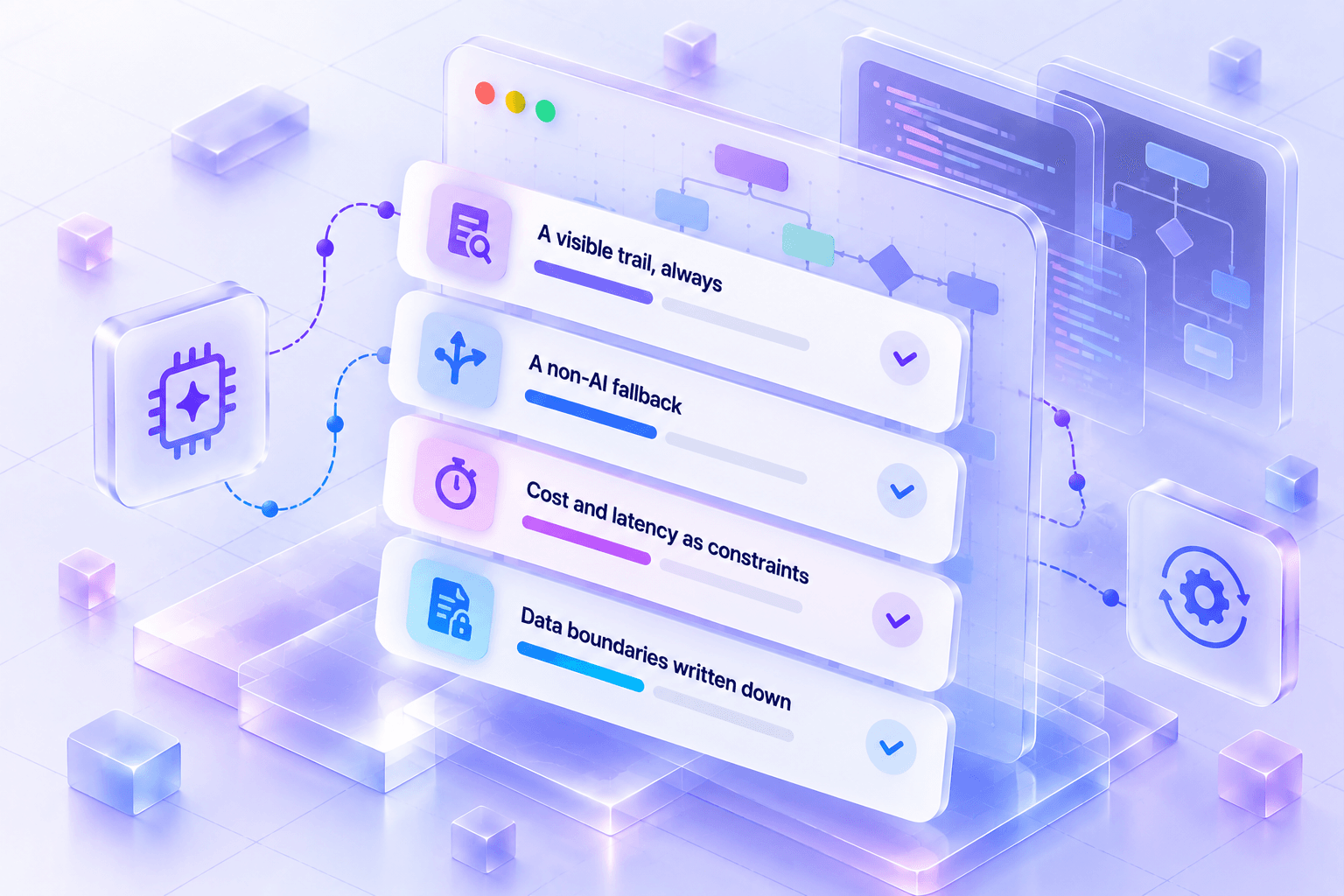
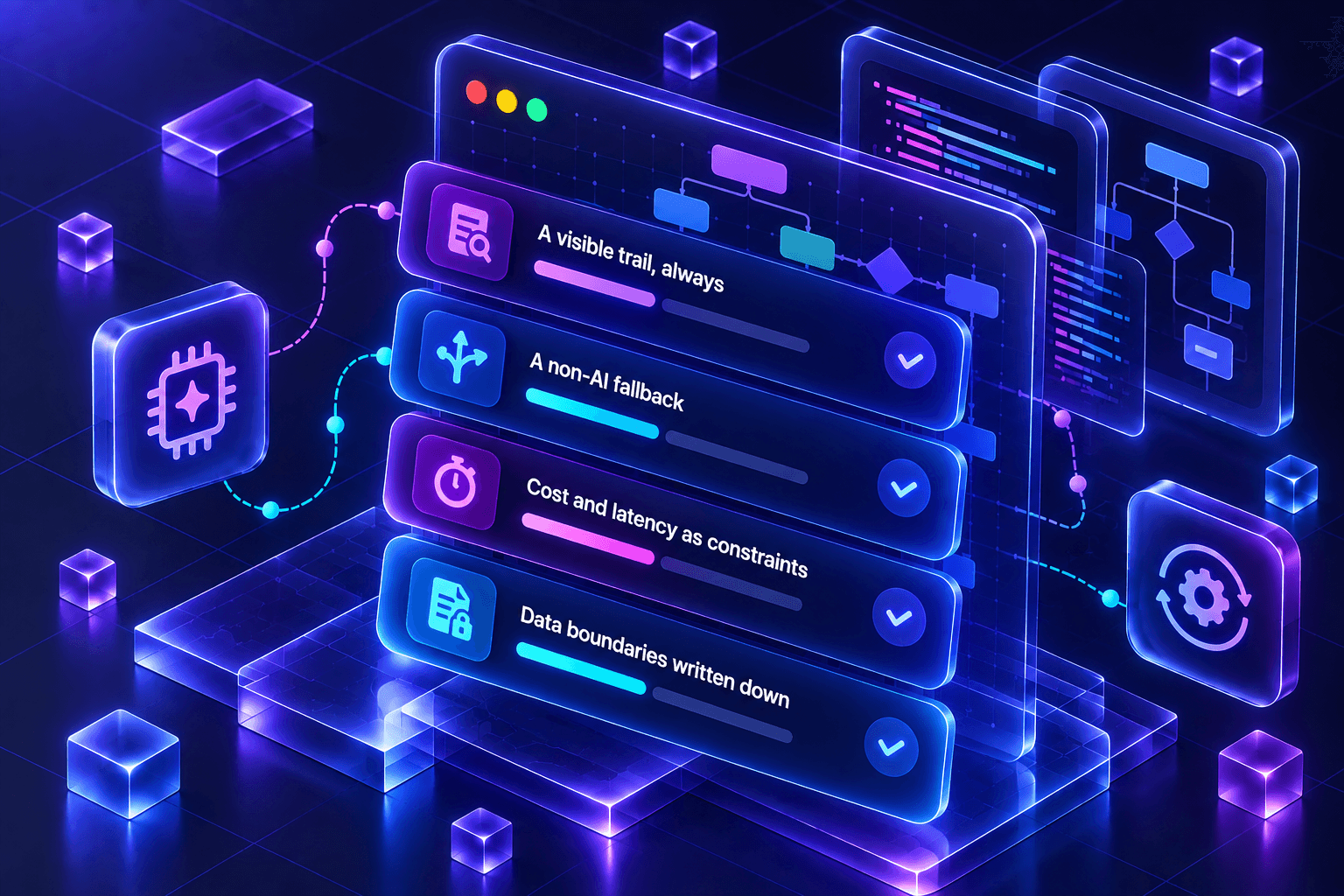
- A visible trail, always
- Every generated output shows what it was based on. If a reader cannot check the work, it is not shippable in an operational product.
- A non-AI fallback
- Every AI feature we ship has a route that does not depend on the model — a manual action, a rules path, a queue for review. Models have bad days; operations do not get one.
- Cost and latency as constraints
- Token cost and response time are treated as product requirements. Caching, smaller models for narrow steps, and doing a step without a model where a query would do.
- Data boundaries written down
- What is sent to a model, what is retained, and what never leaves — decided explicitly, and reflected in the privacy documentation rather than assumed.
The order things actually happen in
Find the step worth automating
Usually one repetitive judgement inside a longer process, not the whole process. We look for the step people describe as tedious rather than the one that sounds impressive in a deck.
Build the evaluation before the feature
A set of real cases with known-good answers, so 'is this better' is a measurement rather than an argument. Without it, prompt changes are superstition.
Ship behind review
The first release drafts and a person approves. The approval rate tells you when — and whether — to loosen it.
Watch it in production
Logged inputs and outputs, a flag on every generated artefact, and a review of the cases people corrected. That correction log is the roadmap.
The stack, and why each piece is in it
- Model integration
- Provider APIs · retrieval pipelines · structured outputModels are called as services behind our own interface, so a provider change is a swap rather than a rewrite, and outputs are validated against a schema before they reach the product.
- Retrieval
- PostgreSQL · vector search · document storesGrounding data stays in the system that already owns it, with retrieval layered on top, rather than a second copy of your records living somewhere new.
- Automation runtime
- Queues · scheduled jobs · webhooksModel calls are slow and occasionally fail, which makes them background work. They run as retryable jobs, never inside a request a person is waiting on.
- Voice
- Text-to-speech · programmable voice · DTMF captureCarrier-grade telephony rather than an app-to-app channel, so a call reaches a handset without an install, and a keypad press comes back as data.
See it, don’t take our word for it
NexBroad-Reachis built by this team, on this stack, and it’s running live — open the product instead of a screenshot of it.
SaaS development
Most SaaS products are easy to demo and hard to operate. The parts that decide whether a product is still maintainable eighteen months in — tenancy, roles, billing, background work, audit — are the parts we build first, because retrofitting them is what stalls a product.
Web development
A marketing site and an operations console are not the same problem, and building them the same way is how one of them ends up slow. We pick the rendering model per surface, then hold the line on payload, accessibility and the states nobody demos.
Tell us what you want built
A short brief is enough to start — what you're trying to do, and roughly for whom. We'll tell you honestly whether it's a fit.